<?xml version="1.0" encoding="utf-8"?><feed xmlns="http://www.w3.org/2005/Atom" ><generator uri="https://jekyllrb.com/" version="3.10.0">Jekyll</generator><link href="https://belsten.github.io/feed.xml" rel="self" type="application/atom+xml" /><link href="https://belsten.github.io/" rel="alternate" type="text/html" /><updated>2026-05-07T17:45:43+00:00</updated><id>https://belsten.github.io/feed.xml</id><title type="html">Home</title><subtitle></subtitle><author><name>Alexander Belsten</name><email>afbelsten at gmail dot com</email></author><entry><title type="html">Ruderman, Cronin, and Chiao hyperspectral natural image dataset</title><link href="https://belsten.github.io/blog/RCC-dataset/" rel="alternate" type="text/html" title="Ruderman, Cronin, and Chiao hyperspectral natural image dataset" /><published>2024-05-17T00:00:00+00:00</published><updated>2024-05-17T00:00:00+00:00</updated><id>https://belsten.github.io/blog/RCC-dataset</id><content type="html" xml:base="https://belsten.github.io/blog/RCC-dataset/"><![CDATA[<p float="middle">
  <img src="../../assets/RCC_rgb_images.png" width="80%" />
</p>

<p><a href="https://drive.google.com/file/d/17Bhk8VeBadXM3lmq-KhDv0-7PkgyfKoJ/view?usp=share_link">Here</a> is a link to download the twelve hyperspectral images  used in ‘Statistics of cone responses to natural images: implications for visual coding’ (1998) by Ruderman, Daniel L and Cronin, Thomas W and Chiao, Chuan-Chin. A basic conversion of the hyperspectral data to RGB can be seen above.</p>

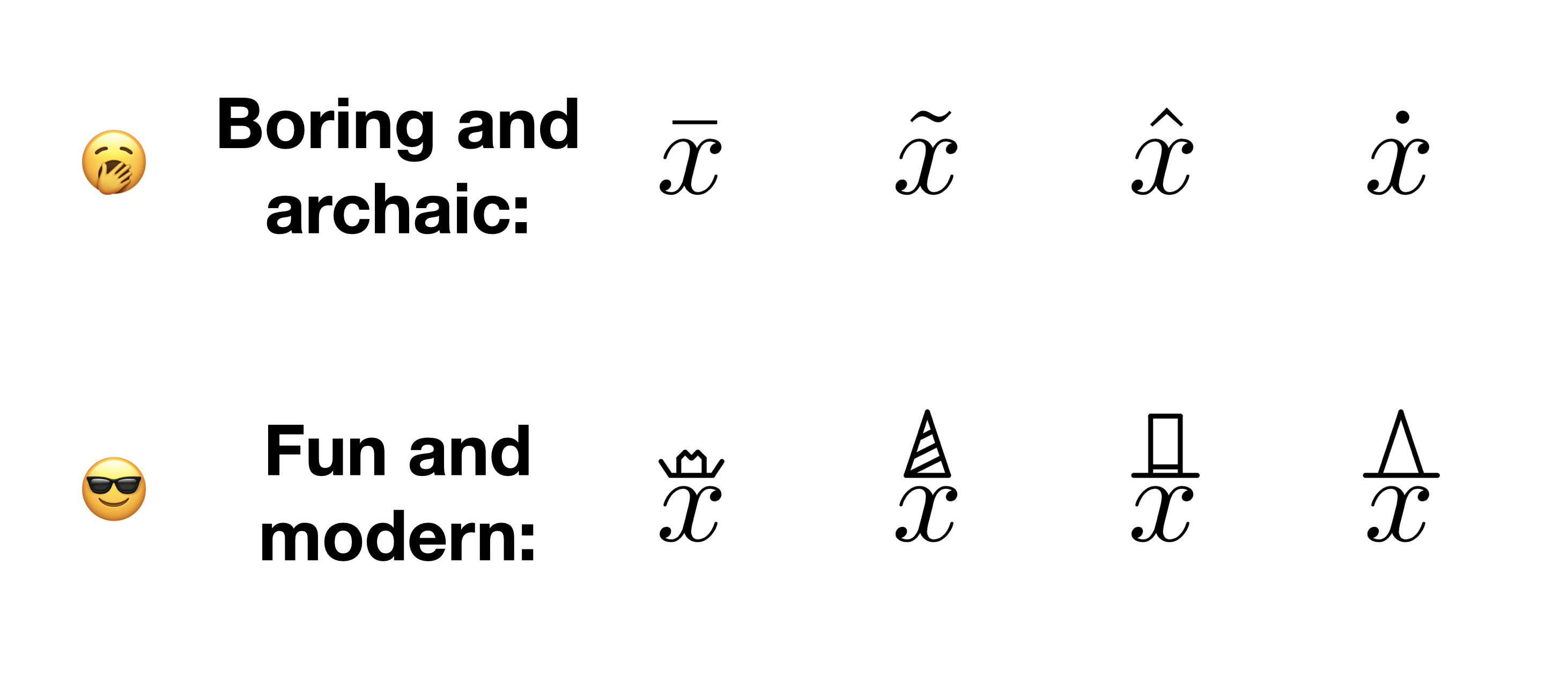
<p>I’ve included a short script on how to read the data in python. Feel free to reach out if there are any issues.</p>]]></content><author><name>Alexander Belsten</name><email>afbelsten at gmail dot com</email></author><category term="blog" /><category term="minimal-mistakes" /><category term="Jekyll" /><category term="update" /><summary type="html"><![CDATA[]]></summary></entry><entry><title type="html">Modernizing Hat Operators in Latex</title><link href="https://belsten.github.io/blog/latex-hats/" rel="alternate" type="text/html" title="Modernizing Hat Operators in Latex" /><published>2023-03-30T00:00:00+00:00</published><updated>2023-03-30T00:00:00+00:00</updated><id>https://belsten.github.io/blog/latex-hats</id><content type="html" xml:base="https://belsten.github.io/blog/latex-hats/"><![CDATA[<p>Are you tired of the same old hat operators? Does <code class="language-plaintext highlighter-rouge">\bar{}</code> or <code class="language-plaintext highlighter-rouge">\hat{}</code> make you want to yawn? Even worse, is the boredom induced by these markers causing you to fall behind in classes?</p>

<p>I say out with the old, in with the new, so check out these hats. Engaging enough to get you that A, subtle enough to let the math do the talking.</p>

<p float="middle">
  <img src="../../assets/latex-hats.png" width="80%" />
</p>

<hr />

<p>BibTeX entry for post:</p>
<div class="language-plaintext highlighter-rouge"><div class="highlight"><pre class="highlight"><code>@misc{belsten2023hats,
  author = {Belsten, Alexander},
  title = {Modernizing Hat Operators in Latex},
  howpublished = "\url{https://belsten.github.io/blog/latex-hats/}",
  date = {2023-03-30}
}
</code></pre></div></div>

<hr />
<p>How to reproduce:</p>
<div class="language-plaintext highlighter-rouge"><div class="highlight"><pre class="highlight"><code>\documentclass{article}
\usepackage{pict2e}

\DeclareRobustCommand{\howdyhat}{
  \begingroup\setlength{\unitlength}{\fontcharht\font`A}
  \begin{picture}(.5,1)
  \roundcap
  \put(-0,-.15){\line(-1,1.5){0.11}} 
  \put(0.5,-.15){\line(1,1.5){0.11}} 
  \put(-0,-.15){\line(1,0){0.5}} 
  \put(0.1,-.15){\line(0,1){0.2}} 
  \put(0.4,-.15){\line(0,1){0.2}} 
  \put(0.1,0.05){\line(1,1){0.075}} 
  \put(0.4,0.05){\line(-1,1){0.075}} 
  \put(0.18,0.12){\line(1,-1){0.065}} 
  \put(0.32,0.12){\line(-1,-1){0.065}} 
  \end{picture}
  \endgroup
}

\DeclareRobustCommand{\partyhat}{
  \begingroup\setlength{\unitlength}{\fontcharht\font`A}
  \begin{picture}(.5,1)
  \roundcap
  \put(-0,-.15){\line(1,3){0.25}}
  \put(-0,-.15){\line(1,0){0.5}}
  \put(0.5,-.15){\line(-1,3){0.25}}
  \put(-0,-.15){\line(1,.5){0.4}}
  \put(0.09,0.075){\line(1,.5){0.27}}
  \put(0.17,0.3){\line(1,.5){0.13}}
  \end{picture}
  \endgroup
}

\DeclareRobustCommand{\abehat}{
  \begingroup\setlength{\unitlength}{\fontcharht\font`A}
  \begin{picture}(.5,1)
  \roundcap
  \put(-0.1,-.15){\line(1,0){0.75}} 
  \put(0.12,-.05){\line(1,0){0.32}} 
  \put(0.1,-.15){\line(0,1){0.7}}
  \put(0.45,-.15){\line(0,1){0.7}}
  \put(0.1,0.55){\line(1,0){0.35}}
  \end{picture}
  \endgroup
}

\DeclareRobustCommand{\witchhat}{
  \begingroup\setlength{\unitlength}{\fontcharht\font`A}
  \begin{picture}(.5,1)
  \roundcap
  \put(-0.15,-.15){\line(1,0){0.85}} 
  \put(0.02,-.15){\line(1,3){0.25}}
  \put(0.52,-.15){\line(-1,3){0.25}}
  \end{picture}
  \endgroup
}

\newcommand\popacaponit[2]{\mathrel{\stackrel{\makebox[0pt]{\mbox{$#2$}}}{#1}}}
\newcommand\howdy[1]{\popacaponit{#1}{\howdyhat}}
\newcommand\party[1]{\popacaponit{#1}{\partyhat}}
\newcommand\abe[1]{\popacaponit{#1}{\abehat}}
\newcommand\witch[1]{\popacaponit{#1}{\witchhat}}

\begin{document}
\begin{equation}
  \howdy{x} \ \ \ \ \party{x} \ \ \ \ \abe{x} \ \ \ \ \witch{x}
\end{equation}
\end{document}
</code></pre></div></div>]]></content><author><name>Alexander Belsten</name><email>afbelsten at gmail dot com</email></author><category term="blog" /><category term="minimal-mistakes" /><category term="Jekyll" /><category term="update" /><summary type="html"><![CDATA[Are you tired of the same old hat operators? Does \bar{} or \hat{} make you want to yawn? Even worse, is the boredom induced by these markers causing you to fall behind in classes?]]></summary></entry></feed>